Category: Senior Fitness

  • Energy Bite 174 – Do You Keep Records?

    Do you keep a record of your exercises? Do you keep a record of your daily weight?

    If you do, that’s great. If you don’t, then how do you know if you are making progress toward your goal, whatever it may be. If you don’t keep a log, how can you track what you are doing, and compare what you are able to do today, with what you were doing yesterday?

    How do you track the plateaus? You know they will come, both in fitness progress, as well as weight loss or gain.

    If you are keeping a record or a log, are you being “brutally honest” with yourself. Nobody sees mine, except me. I don’t lie to myself by fudging numbers.  It pays in the long run to be honest on your logbook.

    Do I cheat? No. Will I do a few more exercises if I’m not at 55 minutes? Sure. But I’m also getting the benefit of those added exercise.

    Both the pros and normal people alike, keep a log book. Bruce Lee kept a log of every routine he ever did. Was he overly obsessive about it? No. He wanted to know where he stood compared with where he wanted to go. You should too.

    How about a weight log. I keep a daily record of my weight. Why? If I gain or lose weight, I can track it against what I have been eating. Oh yes, we make a menu at the beginning of the week and I note any deviations. . You don’t need to keep them, but it’s kind of interesting to have followed my weight loss progression, and compare what I was eating then against what I am eating now.

    It’s also nice to watch the plateaus as they happen, both in weight and in exercise. At my age, I am not looking for progress as such, but I am looking to maintain my muscle structure and keep my weight stabilized.
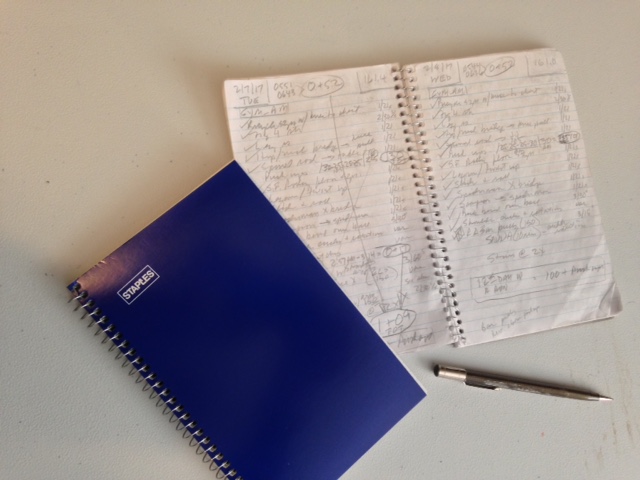
    I use a simple small notebook from Staples for my exercise log (see picture). I list the exercises I do and how many times I do them. It’s mind numbingly simple.
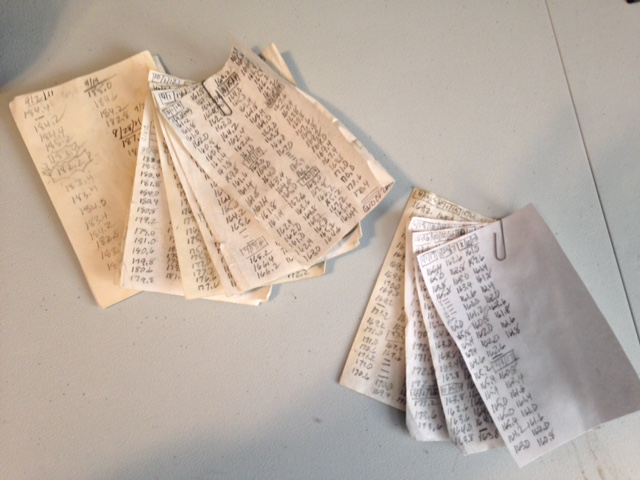
     

    I write my weight down every morning on 5 X 7 index cards. I use both sides of the card and I fill up four or five cards for the year (see picture). Even simpler.


    So if you’re not keeping a record, it really no big deal. But if you’re working toward an exercise or weight goal, it might be nice to track your progress. Give it a try. You’ll be surprised at how much your weight will fluctuate over a week, as well as how much more exercise you can do today compared to a month ago. It’s great for self-esteem, too.

    Thank you for reading.


    463 wds

  • Energy Bite 173 – A Way to Lose Weight that Worked

    I am consistently being asked, “How can I lose weight?” or “What is the best weight loss diet?” I can answer that very simply in four words: “I don’t know, but . . . ”.

    I do know that there are lots of ways to lose weight and a lot of diets. Many of the various weight loss diets work. You will lose weight. You may not keep it off. Many of the diets might not be the healthiest way to eat long term, but most will result in weight loss.

    There is a huge difference between a quick weight loss diet, and a healthful long term eating program. The problem is that there are bookstore and library shelves filled with books on both quick weight loss diets, and long term eating and nutrition plans. They are all written by experts and they are mostly different with contradictory concepts. There are Vegan, Vegetarian, Paleo, Mediterranean and others. These are different than basic quick weight loss diets. So, what do you choose?

    I have no idea what really is “best”. But I can tell you what worked for me. I was 197 pounds in 2010. Today I am 165 pounds and have been at 165 pounds for years. I was not terribly “fat” but I was noticeably overweight. I had a big stomach and a layer of fat all over my body. I was exercising, but mostly just going through the motions. I was certainly not fit.

    I made a “sea change” in 2010. I created a new self-image goal for myself. I decided — that’s a key word —  to take back my health and get fit again. It worked! I started doing a “real” exercise program. I still do the same basic exercise program today. I cut out all alcohol (I had let it get ahead of me). I changed my eating habits by cutting slightly back on red meat. I didn’t cut it out; I like a good steak. I increased my vegetable intake. I eat broccoli now (with some herbs and spices to disguise the taste). I cut way back on refined sugar and white flour (certainly the two unhealthiest culprits). I still eat French and Italian bread once in a while, and pizza on Friday night occasionally. I was never a big dessert eater except for occasional ice cream on weekends. I’ve recently cut that out and surprisingly, don’t really miss it. And by the way, my wife, Edie, is right beside me 100% of the way.

    I feel fantastic and I have a “glimmering” of six-pack abs at age 76. I don’t miss eating junk. It took a little while to develop a taste for some of the vegetables, but now I love most of them. I have not been “sick” a day since I started, other than an occasional very short term cold. I did have some surgery to replace a defective heart valve (nothing to do with clogged arteries).

    The point is that losing weight can be a simple process if you let it. Yes, you have to make some changes in your eating habits. It took a long time for me to lose the 30 pounds of mostly excess fat. But it worked. There are some subtleties that need to be addressed individually. Some people are allergic to gluten, others are allergic to other foods. These are easy to deal with as long as they can be identified. But if you are overweight and want to lose, I can offer up what worked for me. Don’t expect miracles. You won’t lose 14 pounds in 14 days as advertised on TV. That’s probably not healthy anyway, and it’s definitely not long term.

    Mentally, you might do a little visualizing and imagining. Visualize what you want to look and feel like and move toward that. Moving toward a real goal is far easier than moving away from what you don’t want. And as you watch your body change, your self-image and attitude toward life will change dramatically.

    If you are overweight and really want to lose a bit, try what I did. Just don’t look for that overnight miracle. Healthy weight loss doesn’t work that way.

    Thank you for reading.

  • Energy Bite 172 – Will Your Expectations of Aging, Age You?

    The mind and the body are intertwined far more than most of us realize. There is an epidemic of depression and feelings of unworthiness among many seniors. This is nothing new and has been going on since the first person started aging and younger people started observing. And the words, the thoughts, and the expectations that we express about aging can actually affect the way we age.

    “The expectations of aging will age you”, says Maxwell Maltz, author of the famous self-help book from the 1960s, Psycho-Cybernetics. He asks the question:

     “Do We Sometimes Think Ourselves into Old Age?”

     The traditional thinking was that a person becomes pretty much useless as he or she passes through seventy years old. The mandatory retirement age for many companies has traditionally been 65 or 70 years old. My father was a “young” 70 years old when he was forced, in 1978, to retire from being a well respected Law Professor at a prestigious Law School. I think they have discontinued the practice of mandatory retirement at age 70 by now. Seniors of that age used to be considered well past their functional prime and pretty much useless to society. No wonder many seniors experience those feelings of depression and unworthiness as they get older.

    Maltz goes on to say:

    “Or, in expecting ‘old age’ and fearing its onset, we may unwittingly do those very things necessary to bring it about. We begin to taper off on both physical and mental activity. Cutting out practically all vigorous physical activity, we tend to lose some of the flexibility of our joints. Lack of exercise causes our capillaries to constrict and virtually disappear, and the supply of life-giving blood through our tissues is drastically curtailed. Vigorous exercise is necessary to dilate the capillaries which feed all body tissues and remove waste products.”

     Beliefs are a powerful motivator, both positive and negative. If our beliefs tell us that we are getting old and there is nothing we can do about it, then we will fulfill our expectations, and get old and decrepit. If, on the other hand, we believe that we have the ability to take positive action in both mind and body to slow the aging process, then we will fulfill those expectations and keep our youthful vigor.

    What are those positive actions? Exercise, eating well, breathing deeply, getting plenty of rest of sleep, and equally important, maintaining a positive mind-set that is optimistic about our longevity and our own usefulness as we age.

    Hmm. That’s a pretty powerful incentive to exercise and to maintain a positive and optimistic mind-set as we move through our 50s, 60s, 70s and beyond, and to continue with physical exercise and optimism the rest of our lives.

    Thank you for reading.