Category: Senior Fitness

  • Energy Bite 165 – Strength Without Moving, Part 2

    Last week I promised I would put up some simple isometric exercises that you could start doing to build strength. They are shown below. But before you do them, here are a few things to be watchful for:

    • Breathe in as you start to build pressure. Breathe out while you are holding the pressure. Breathe in again as you release the pressure. You should not hold your breath during isometric exercises. Doing these exercises may increase your blood pressure slightly. If you have consistent high blood pressure, you may want to check with a doctor before you do them. Some studies show that doing isometric exercises may result in a reduction in your resting blood pressure, even though you may experience and increase in blood pressure as you are doing them.
    • You will be putting a lot of pressure on your wrists during a couple of the exercises. You may experience some “discomfort” in your wrists until they get used to the effort.
    • If you are new to exercise, these are a great way to start. You should notice an increase in strength by the end of the first week.
    • Unlike using heavy weights, you can do these isometric exercises every day up to twice a day. OK, give yourself a rest one day a week.
    • Focus on what you are doing. Focus on the part of the body that is being worked. Visualize the new strength developing as you are doing each exercise.

    Here are five simple isometric exercises that you can do anywhere at any time. I suggest you start by doing them once in the morning and once in the afternoon.

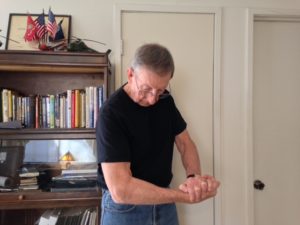
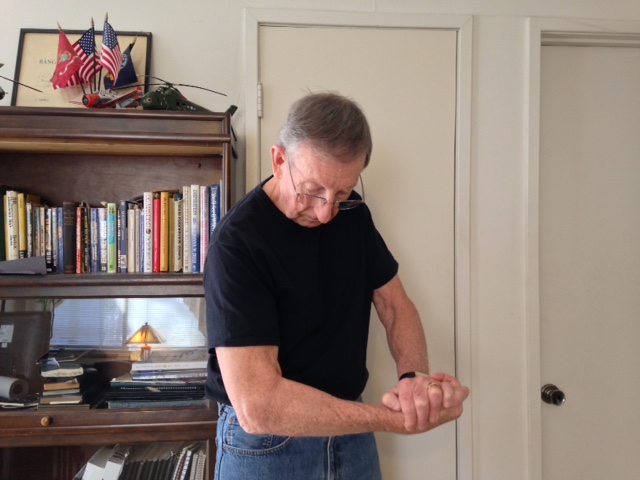
    1. Bicep isometric: Bend your right arm 90 degrees at the elbow (see picture) with your right palm up. Place your left hand img_1250palm down over the right hand or wrist. Push up as hard as is comfortable with your right hand as you resist with the left hand. Hold for 7 to 12 seconds. Breathe naturally. Change arms. Do it once in the morning and once in the evening.
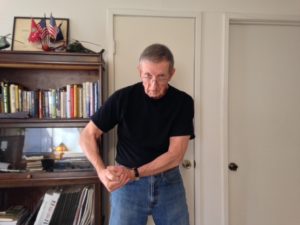
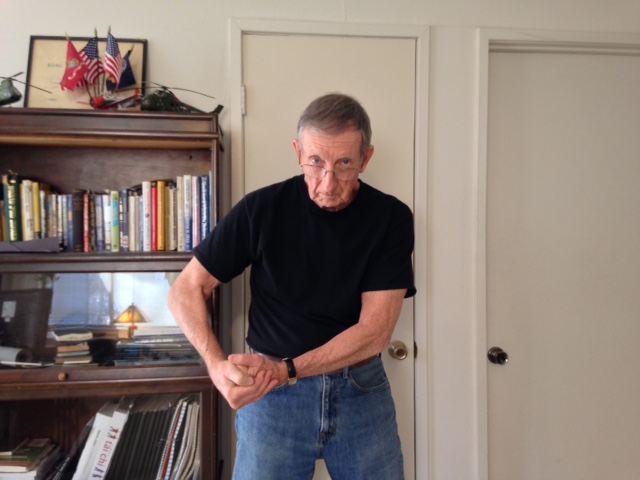
    2. Chest developer: Put your left fist in your right palm at or just below belt level. Place both hands at the right hip and pushimg_1252 your left fist against your right palm as hard as you can while you resist with the right hand. Hold for 7 to 12 seconds. Then switch sides and do the same thing on the other side. Do this once in the morning and once in the evening.
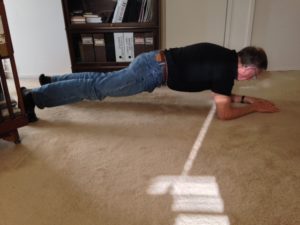
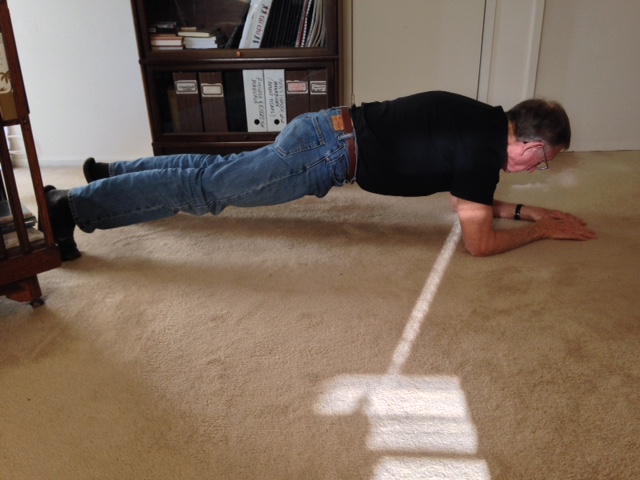
    3. Basic Plank: This is a powerful abdominal muscle developer. Start on your hands and knees and extend into a positionimg_1264 where your body is straight, your feet are up on your toes, and your are supported by your elbows. Don’t let your body sag nor bend at the waist. Hold for fifteen seconds to start and slowly work up to a minute over time. Extend the time as you get better at doing it.
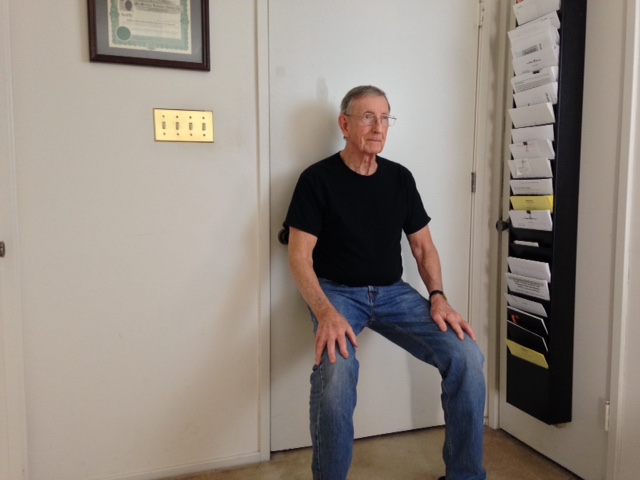
    4. Wall squat: This powerful isometric leg exercise will develop strong thighs (quadriceps). Stand against a wall or door (make img_1270sure the door opens toward you). Start by bending your legs slightly and holding for fifteen seconds. As you get stronger, you can bend your legs more and hold the position longer. Never bend your legs past 90 degrees. Will your legs be shaky and sore after the first few times you do it? If you don’t bend your legs too much the first few times, probably not. If you try to bend your legs to 90 degrees the first few times, probably yes. Do this once in the morning and once in the afternoon.
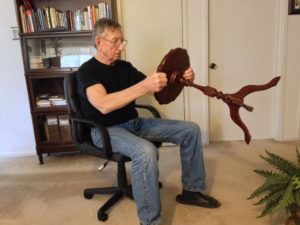
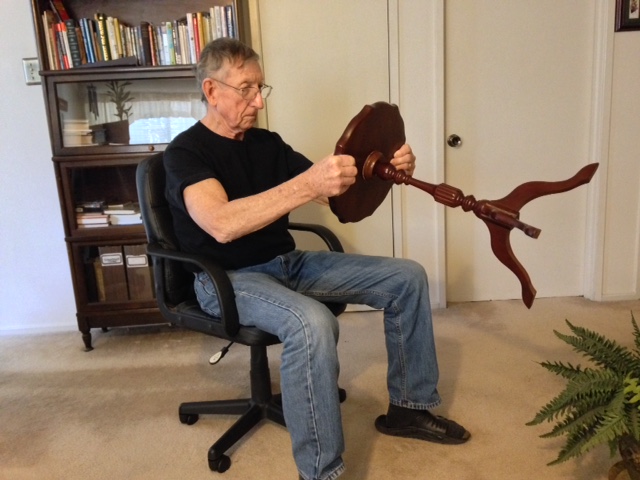
    5. Steering wheel isometric: This is one of the easiest and most convenient arm and chest isometric exercises you can do. When you are sitting at a traffic light in your car, hold the steering wheel wimg_1278ith your hands on each side of the steering wheel. Push together toward the middle as hard as you can and hold for ten seconds. Do this a couple of times a day. It will help you keep from being frustrated at a long light and will make your chest and arms dramatically stronger. It looks like I need a new car.
    These are just a few isometric exercises that will build your strength and muscle power. These will not turn you into a body builder. They will strengthen and harden your muscles. They are not weight loss exercises, but as you lose fat on your body through proper diet and other exercise, your muscles with begin to show and your body shape will improve.

    Isometric exercises are powerful strength builders. You should notice your entire body feeling stronger by the end of the first week. It’s all progress from there.

    Thank you for reading.


  • Energy Bite 164 – Strength Without Moving, Part 1

    Remember Charles Atlas? In the 1930s, 1940s and 1950s, the most famous and popular physical fitness course in the world was Charles Atlas’ Dynamic Tension* program, sold through his famous “Kick sand in your face” graphic ads in the comic strips and magazines of the time. It was used by men and women alike, but was promoted mostly to men with the promise that women would be attracted to them because of their new and improved robust fitness.

    Charles Atlas’ real name was Angelo Siciliano. He was the winner of one of Physical Culture Magazine’s World’s Best Body contests. But he was even more famous for his “Kick Sand in Your Face” advertisements in magazines and comic books in the forties and fifties. Because of those ads, his Dynamic Tension course sold more exercise courses than anyone in history.   The course also worked as advertised!

    The course was built around the concept of “self-resistance”, or pitting one muscle against another and contracting it as hard as possible, either without or with movement.. Today these are called Isometric Contraction and Isotonic exercises. Isometric exercises are when you pit one muscle against another muscle or an inanimate object, without any movement. Isotonic exercises involve the same kind of muscular contraction, but with movement around the joints for partial or full range of motion.

    According to Wikipedia:  “Atlas’ Dynamic Tension” program consists of twelve lessons and one final perpetual lesson. Each lesson is supplemented with photos of Atlas demonstrating the exercises. Atlas’ lesson booklets added commentary that referred to the readers as his friends and gave them an open invitation to write him letters to update him on their progress and stories. His products and lessons have sold millions, and Atlas became the face of fitness. Among the people who took Atlas’ course were Max Baer, heavyweight boxing champion from 1934 to 1935; Rocky Marciano, heavyweight boxing champion from 1952 to 1956; Joe Louis, heavyweight boxing champion from 1937 to 1949; British heavyweight weightlifting champion and Darth Vader actor David Prowse; and Allan Wells, the 1980 Moscow Olympic Games 100 meter champion.

    Legend has it that Mahatma Gandhi inquired about the course in response to one of his ads. Hmm. Apparently he didn’t take the course.

    What are some of the major benefits of this type of exercise? First, it is nearly impossible to be injured during exercise using this method because one’s own muscles provide the force and, as they tire, the force used also decreases. Second, you need no equipment other than possibly a chair or two. There are no dumbbells, barbells, stretch bands or other equipment. The Third benefit is that historically the program seems to work as advertised. A major barbell manufacturer once challenged Atlas’s claims with the FTC. Atlas won.

    For seniors, note that you should slowly work up to using maximum strength, and you should guard against holding your breath, for blood pressure reasons mostly.

    An interesting sidenote: Charles Atlas was a protege of Bernarr Macfadden, the godfather of American health and fitness. Another Macfadden protege was a writer for Macfadden’s magazine by the name of Paul Bragg, the founder of the first health food stores in the United States. Paul Bragg is also well known for his own protege, Jack Lalanne.

    In his later years, Charles Atlas still performed 50 knee-bends, 100 sit-ups, and 300 push-ups every morning. He died at age 79 (some say 80) in 1972

    Another surprising name in the area of Isometric exercise is Bruce Lee, the martial artist and movie actor. I say surprising because many believed that isometric exercises stifled muscle speed and range of motion of the joints. But Bruce Lee had blazing speed and full range of motion in spite of using isometric exercises.  According to the book, The Art of Expressing the Human Body, written by Bruce Lee and compiled and edited by John LIttle after Lee’s death, Lee was a huge fan of isometric exercise and performed what he called “the Basic 8” (isometrics) as part of his routine throughout a major portion of his career.

    Next week, in Part 2, I’ll describe some of the best strength building isometric and isotonic exercises we, as seniors, can do to build and protect our Strength, Health, Fitness and Personal Energy. The exercises will be excerpted from my ebook entitled, Fitness and Personal Energy (Working Title) to be for sale online by year end.

    Thank you for reading.


    *”Dynamic Tension” is a registered trademark of Charles Atlas, Ltd.

    Note: Pardon my grammar. Atlas’ vs. Atlas’s reflects the Associated Press Style Manual vs. the Chicago Manual of Style. Go figure.


  • Energy Bite 163 – Health and Fitness vs. Chronic Disease

    I recently watched a video/podcast by Lewis Howes, a former professional Arena Football player and author of School for Greatness, and Greg Glassman, founder of Crossfit, arguably the most popular fitness phenomena in the world today.

    A couple of comments made during the entire hour and twenty minute interview really caught my attention. I think you’ll find them interesting too.

    I found the most interesting comment to be around the subject of the number of injuries that come out of the Crossfit program as well as other exercise programs. Of course there is the potential for injury in all forms of exercise, from doing jumping jacks in elementary school to sports like rock climbing, football, skiing, and other active sports.

    Glassman noted that approximately 70% of Americans will die as a result of chronic disease, long before their expected lifespans have run out. 30% of Americans will die of other causes including old age. He said that although there is a likelihood of injury in any form of exercise, Americans should be willing to trade a few strains and sprains to offset the risk of dying prematurely as a result of chronic disease. He said that to bring the injury rate from exercise down to zero, you would have to cut back on the effectiveness of any fitness program.

    Glassman cited a British Exercise Scientist who observed that our modern times are the first times in history that people had to “exercise” to find health. Our ancestors got all the “exercise” they needed from their daily routines. He said that nobody “invented” the chin up — our ancestors knew how to climb trees just fine. Nobody “invented” the dead lift. Our ancestors were always picking up heavy things off the ground.

    That same British Exercise Scientist also cited a study of British bus operators and noted that the stand-up ticket takers has less heart attacks and lived longer than the sit down drivers, even though they may have been hired at the same time and received the same pay. Interesting. Is sitting really today’s smoking?

    Glassman suggested that Crossfit’s program of fitness is the most elegant solution to the problem of people contracting and dying of chronic disease. I think this would apply to any program of exercise.

    There’s a lot of good food for thought about the benefits of exercise in that interview. If you want to watch the entire hour and twenty minutes, here’s the link: https://www.youtube.com/watch?v=Ts94YY7VNoY.

    Glassman said that it’s hard to measure the benefits of exercise and fitness against the costs of chronic disease. He said that we’ll never count the heart attacks that never happen or the Alzheimer’s that never develops. Well said.

    Thank you for reading.